
Spray booth filters are easy to overlook because they work quietly in the background. Yet they have a direct role in controlling airborne particles, supporting consistent airflow, and keeping the spraying environment cleaner. When filters become clogged, damaged, or unsuitable for the application, the effects can show up in both air quality and the quality of the finished surface.
Understanding how spray booth filters work makes it easier to choose the right types, maintain them properly, and recognise when replacement is needed. A well-planned filtration system supports the booth as a whole rather than simply trapping visible dust.
A spray booth moves controlled volumes of air through a defined workspace. During this process, the air may carry dust, fibres, overspray, paint particles, and other contaminants. Filters capture unwanted material at different stages of airflow.
Most spray booth filtration systems use more than one type of filter. The exact arrangement depends on the booth design, coating process, airflow configuration, and working environment.
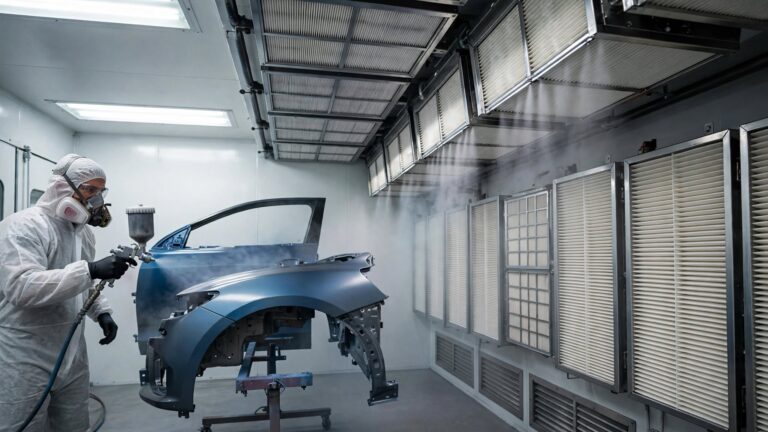
Intake filters clean the air entering the booth. Their main purpose is to reduce the amount of dust and other airborne contamination reaching the spraying area.
This matters because even small particles can settle on a freshly coated surface. The result may be visible imperfections that require sanding, polishing, or recoating.
Exhaust filters deal with air leaving the spraying area. They capture overspray particles before the air continues through the exhaust system.
Effective overspray capture also helps reduce paint deposits within downstream components. However, exhaust filters gradually become loaded with material, so they need to be checked and replaced according to the booth’s operating conditions and filter manufacturer’s guidance.
Air quality inside a spray booth depends heavily on controlling contamination as air enters, moves through, and exits the workspace.
Clean intake filtration reduces unwanted particles before they reach the spraying zone. At the exhaust stage, appropriate filters collect suspended overspray. Together, these filtration stages help create a more controlled working environment.
Filters should still be viewed as one part of a larger system. Booth ventilation, extraction, airflow design, coating materials, operating procedures, and maintenance practices all influence air quality.
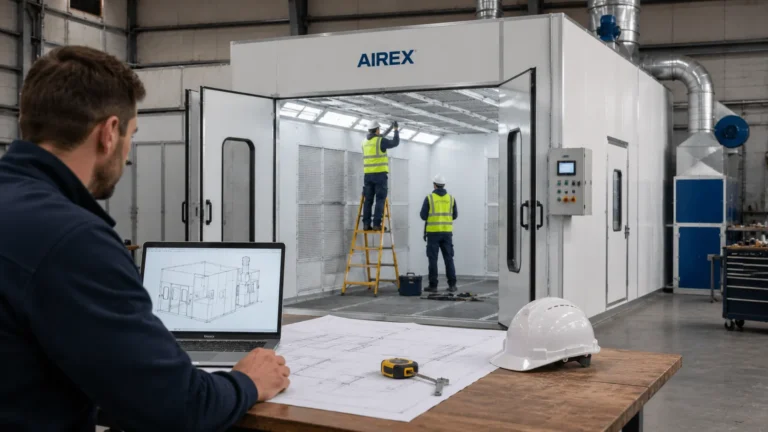
The booth itself also needs to suit the work being performed. Factors such as component size, airflow path, and working space can affect how efficiently filtered air moves around the product. This relationship between booth dimensions and operating efficiency is also relevant when considering Bespoke Spray Booths: Why Custom Sizing Can Improve Productivity.
A filter affects more than the cleanliness of the air. Its condition can influence how the entire ventilation system operates.
As a filter collects contaminants, resistance to airflow can increase. If it becomes excessively loaded, the booth may struggle to maintain its intended airflow characteristics. This can affect how overspray moves through the workspace and how effectively contaminants are carried toward the extraction system.
Regular filter inspection therefore supports stable booth operation. It can also help identify problems before they become more disruptive.
Surface preparation is important, but contamination can still enter the spraying area after a component has been cleaned. Dust carried by incoming air may settle during coating or while the finish is still wet.
Proper intake filtration helps limit this risk.
Consider a workshop where doors frequently open onto a dusty production area. Without effective filtration, some of that airborne material could enter the booth and reach the workpiece. A suitable intake filter provides an additional barrier between the surrounding workshop and the coating area.
Filtration cannot eliminate every possible finish defect, but it helps control one important source of contamination.
Spray booth filters are not interchangeable simply because they have similar dimensions. Filter media, construction, efficiency, airflow resistance, and intended use can vary.
When selecting replacements, consider:
The booth manufacturer’s specifications
Whether the filter is intended for intake or exhaust use
The type of coating or spraying process
Required airflow characteristics
Filter dimensions and installation direction
The operating environment around the booth
Using an unsuitable filter can create problems even when it physically fits the frame. A filter with inappropriate resistance, for example, may interfere with the airflow conditions the booth was designed to maintain.
A visual inspection is useful, but appearance alone should not determine when a filter is replaced. Some filters may become significantly loaded before the problem is obvious from the exposed surface.
Possible signs that filters need inspection include reduced airflow, unusual pressure behaviour, changes in overspray movement, visible filter damage, or increasing contamination within the booth.
Maintenance intervals also vary. A booth used throughout the working day may load filters differently from one used occasionally. The coating material, production volume, surrounding dust levels, and filter type can all affect service life.
For this reason, replacement should follow the booth and filter manufacturers’ recommendations rather than relying on a universal timetable.
Even a correctly specified spray booth filter may perform poorly if it is installed incorrectly. Gaps around the filter frame can allow unfiltered air to bypass the media, while damaged or poorly seated filters may reduce effective particle capture.
Routine maintenance should include checking filter condition, frames, seals, and surrounding areas. Replacement filters should be fitted in the correct orientation where airflow direction is specified.
It is also useful to keep basic maintenance records. Tracking replacement dates and operating conditions can help a workshop understand how quickly filters become loaded under its normal workload.
Spray booth filters contribute to both air quality and reliable booth performance by controlling dust, overspray, and other airborne contaminants. Intake filters protect the spraying environment from incoming particles, while exhaust filters capture material carried away from the work area.
Their effectiveness depends on correct selection, installation, inspection, and replacement. Filters also need to work alongside appropriate ventilation and airflow design rather than being treated as a standalone solution.
Giving filtration regular attention can help maintain a cleaner spraying environment, support more consistent airflow, and reduce avoidable contamination during finishing work.