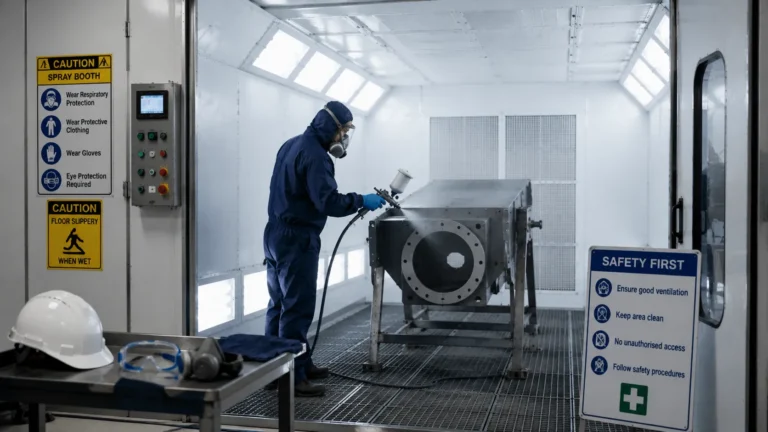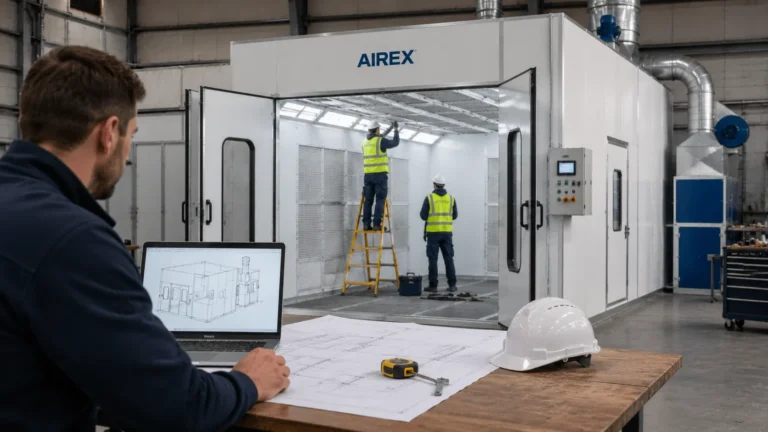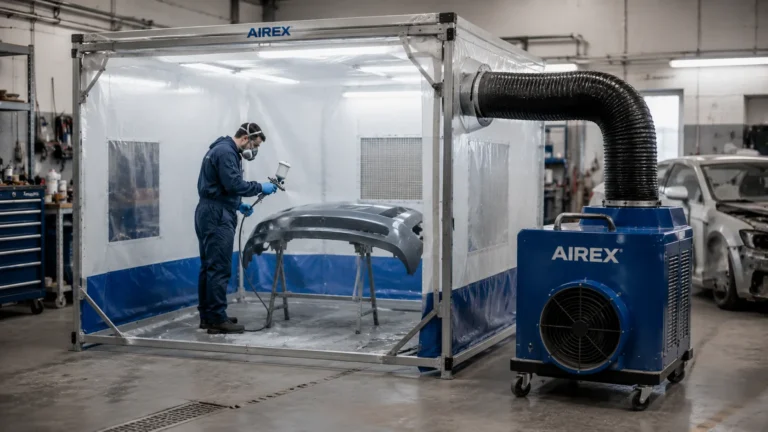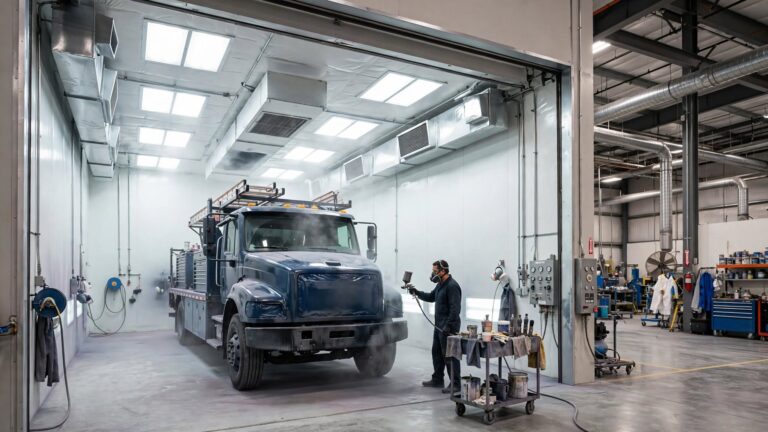

A spray booth is more than an enclosed area for applying paint or coatings. Its dimensions, airflow, access points, lighting, filtration, and internal working space all influence how comfortably and efficiently operators can complete finishing tasks. When a standard booth does not match the products being coated or the workflow of a facility, seemingly small compromises can create unnecessary handling, awkward movement, and production delays.
Bespoke spray booths are designed around specific operational requirements rather than fixed standard dimensions. Custom sizing can be particularly useful for businesses handling unusually large, small, long, or irregular products. The aim is not simply to create a larger booth, but to provide an appropriately sized working environment that supports consistent processes, efficient movement, and practical use of available floor space.
A bespoke spray booth is a purpose-designed enclosure configured for a particular application, workspace, or production process. Instead of selecting a standard booth and adapting operations around it, the booth can be planned according to the items being sprayed and the way employees need to work around them.
Customisation may involve overall length, width, and height, but sizing is only one consideration. Booth configuration can also take account of door positions, loading arrangements, operator access, airflow design, extraction, filtration, lighting, and surrounding equipment.
For example, a workshop coating long fabricated components may require additional internal length without needing excessive width. A facility handling bulky machinery may instead require greater door clearance and working space around several sides of the product.
The relationship between booth dimensions and productivity is often practical rather than complicated. Operators need enough room to position equipment, move safely around the workpiece, and apply coatings without constantly adjusting the product or their working position.
An undersized booth may require components to be repositioned several times during preparation and spraying. Large items might also need to be disassembled before entering the booth and reassembled later.
A correctly sized custom spray booth can reduce unnecessary handling by accommodating products in a more suitable orientation. This can simplify the movement of items from preparation through coating and onward to the next production stage.
The benefit depends on the actual workflow. Making a booth unnecessarily large does not automatically increase productivity, which is why accurate planning is important.
Internal dimensions should consider more than the size of the largest workpiece. Operators, spray equipment, hoses, access platforms, trolleys, and other tools may also require space.
Adequate working clearance allows operators to approach surfaces at suitable angles and move around products without continually navigating tight spaces. This becomes particularly important when coating complex shapes where several surfaces must be reached during the same process.
Different industries place very different demands on spray booth design. A booth intended for small fabricated components will have different requirements from one used for commercial vehicles, industrial machinery, furniture, or large structural assemblies.
Before specifying bespoke spray booths, businesses should examine the complete production process rather than focusing only on the physical dimensions of the products.
Useful factors to consider include:
Maximum and typical workpiece dimensions
Production volume and product variation
Loading and unloading methods
Required operator working space
Material movement before and after spraying
Available building height and floor area
Extraction, filtration, and airflow requirements
Access for inspection, cleaning, and maintenance
Considering these factors together can help prevent a situation where the booth itself fits the product but does not integrate effectively with the rest of the facility.
Custom sizing also affects spray booth ventilation. Airflow must be considered as part of the overall booth design because changing the internal dimensions changes the space through which air needs to move.
Simply enlarging an existing booth concept without reviewing its ventilation arrangement may create an unsuitable working environment. Extraction and air movement need to correspond with the booth geometry, coating process, filtration arrangement, and intended application.
More space is not always an advantage. An oversized booth occupies valuable floor area and increases the internal volume that the ventilation system must manage.
The objective of custom sizing should therefore be appropriate dimensions rather than maximum dimensions. A well-planned booth provides sufficient clearance for products and operators while avoiding unused space that offers little operational value.
Product movement can become a significant source of lost time if the booth entrance does not match the facility’s handling methods.
A bespoke spray booth can be planned around existing material-handling arrangements. Depending on the operation, this might involve suitable doors for wheeled equipment, overhead access for suspended components, or an arrangement that allows products to move through the booth as part of a wider production sequence.
Door size deserves particular attention. A booth may have sufficient internal space but still create a bottleneck if its entrance makes loading difficult.
Industrial buildings rarely provide unlimited space. Columns, ceilings, existing machinery, walkways, preparation areas, and other production equipment can restrict where a spray booth can be installed.
Custom sizing provides greater flexibility when fitting a booth into these constraints. Instead of dedicating additional space to a standard enclosure that is larger than necessary, the booth can be configured around genuine operational needs.
However, fitting a booth into a restricted area should not come at the expense of appropriate access, ventilation, maintenance requirements, or safe working practices. Installation planning needs to consider both the booth and the surrounding environment.
Custom design can make sense when standard booth sizes consistently create operational compromises. This is especially relevant when products have unusual dimensions, production involves frequent handling difficulties, or the available building layout makes conventional booth configurations impractical.
It may also be useful when a facility expects to process several product types. In this situation, sizing should consider the normal workload as well as occasional larger items. Designing exclusively around the largest possible component could result in excessive unused capacity during everyday operation.
The decision should therefore be based on workflow analysis rather than size alone.
Bespoke spray booths can improve productivity when their dimensions and configuration are closely matched to real production requirements. Appropriate sizing can reduce unnecessary product movement, provide operators with practical working clearance, improve loading arrangements, and help the booth integrate more effectively with surrounding processes.
Custom design should not simply mean building a bigger enclosure. Booth dimensions need to work alongside airflow, filtration, access, maintenance, material handling, and available factory space. By considering these elements together, businesses can create a spray booth layout that supports a more practical and efficient finishing process without introducing unnecessary capacity or complexity.